
Completely out of shape at 55 is not a failure — it’s a starting point. And if you’re reading this, it means something inside you already wants to change.
Maybe you’ve been sedentary for years.
Maybe work, stress, family, or health issues slowly pushed movement out of your life.
Maybe you’ve tried before — and stopped.
The real question isn’t “Why did this happen?”
The real question is:
Where do I start safely at 55 — without hurting myself?
This guide will show you exactly how to restart exercise after 50 using a safe, progressive structure — whether you have equipment or nothing at all.
And most importantly:
You will not start like you’re 25.
You will start intelligently.
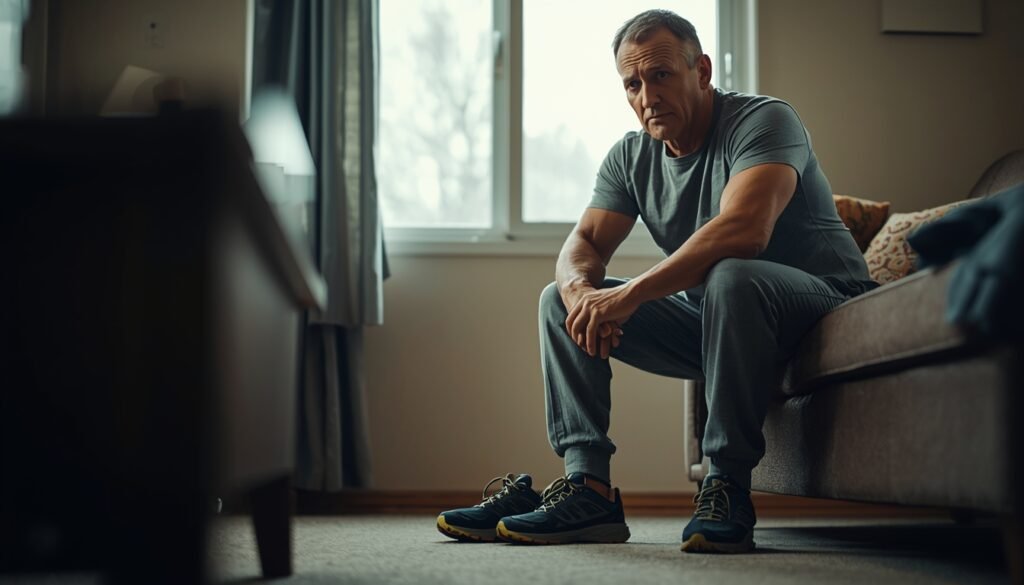
Why Being Out of Shape at 55 Feels Overwhelming
When you’re completely out of shape at 55, everything feels heavier:
- Stairs feel longer
- Knees feel tighter
- Energy feels lower
- Recovery feels slower
But here’s something important:
This is biology — not weakness.
After 50:
- Muscle mass naturally decreases
- Joint lubrication reduces
- Recovery slows
- Cardiovascular efficiency declines if unused
That doesn’t mean decline is permanent.
It means the restart must be gradual.
And that’s where most people fail.
The Biggest Mistake People Make After 50
When someone decides to change, they often do this:
- Start too intense
- Exercise too long
- Ignore early warning signs
- Feel extreme soreness
- Quit
Then they conclude:
“Maybe I’m just too old for this.”
You’re not too old.
You just tried to start like you were 30.
At 55, your strategy must change.
The goal is not intensity.
The goal is repeatability.
If you want a deeper step-by-step breakdown, read our full Beginner Exercise Guide for Seniors: What to Do, What to Avoid, and What to Expect (2026).
Step 1: Decide Your Starting Scenario
Before we talk about duration or intensity, we need clarity.
Do you:
A) Have no equipment at all?
B) Have an exercise bike?
C) Have a treadmill?
D) Have a small home gym or resistance equipment?
Each starting point changes how you begin.
Let’s break it down safely.
Scenario A: No Equipment at All
If you’re completely out of shape at 55 and have no equipment, the safest place to start is walking.
Week 1–2 Plan
- 10–15 minutes per session
- Comfortable pace (you can talk while walking)
- Flat surface
- Proper shoes
Rule:
If you feel muscle fatigue, that’s normal.
If you feel sharp joint pain, stop.
There’s a difference between discomfort and warning pain.
Progression rule:
Increase duration by 5 minutes per week.
Never increase speed and time at the same time.
If you’ve been sedentary for years, this complete guide will help you restart safely: Start Exercising at Home After Sedentary Lifestyle: Safe Guide for Beginners and Seniors (2026).

Scenario B: You Have an Exercise Bike
An exercise bike is one of the safest beginner tools after 50.
Why?
- Low joint impact
- Controlled movement
- Seated support
Week 1–2 Plan
- 10–15 minutes
- Very low resistance
- Upright posture
- Steady breathing
Progression:
Add 3–5 minutes per week.
Only increase resistance after 3–4 consistent weeks.
If knees hurt sharply, reduce resistance immediately.
If space or noise is a concern, see why many beginners choose the Indoor Exercise Bike for Apartment: Quiet, Compact & No Neighbor Complaints (2026).
Scenario C: You Have a Treadmill
A treadmill allows controlled walking — but beginners must avoid common mistakes.
Week 1–2 Plan
- 10–20 minutes
- No incline
- Do not hold rails tightly
- Walk naturally
Holding the rails constantly reduces balance development.
After 3 weeks, you may add a small incline (1–2%).
Never start with incline.
To understand how your body adapts over time, read Treadmill for Adults Over 50: What Happens to Your Body in 10, 30, 60 and 100 Days.
Scenario D: You Have a Small Home Gym
If you own light dumbbells, resistance bands, or a compact home station:
Start slow.
Week 1–2 Plan
2 sessions per week only.
Focus on basic patterns:
- Chair squats
- Wall push-ups
- Light rows
- Core stability
No heavy loads.
No explosive movement.
At 55, strength returns safely when controlled — not forced.
📊 Comparison Table — Safest Starting Options at 55
What’s the Best Way to Restart Exercise After 50?
| Activity | Joint Impact | Cardio Demand | Strength Demand | Recommended Start Time |
|---|---|---|---|---|
| Walking | Low | Moderate | Low–Moderate | 10–15 min |
| Exercise Bike | Low | Moderate | Moderate | 10–15 min |
| Treadmill | Low–Moderate | Moderate | Low–Moderate | 10–20 min |
| Light Strength | Variable | Low | Moderate | 2x/week short sessions |
Notice something:
None of them say “go hard.”
They say “start controlled.”
The 4-Week Safe Progression Model
If you’re completely out of shape at 55, this is your safest structure:
Week 1
Light movement only. Build the habit.
Week 2
Increase time slightly.
Week 3
Add mild resistance or light strength.
Week 4
Increase intensity slightly — not duration and intensity together.
Golden rule:
Never increase volume and intensity at the same time.

How Many Minutes Should You Exercise at 55?
If sedentary:
10–15 minutes is enough.
After adaptation:
20–30 minutes is sustainable.
More than 40 minutes early on is unnecessary.
Consistency beats volume.
If you’re unsure about safe daily duration, this guide explains exactly how long you should exercise: How Many Minutes of Exercise Per Day Is Safe for Beginners Over 50 at Home? (2026).
Warning Signs You Should Not Ignore
Stop and reassess if you experience:
- Sharp joint pain
- Chest discomfort
- Dizziness
- Extreme fatigue lasting 24+ hours
Exercise should challenge you — not punish you.
What If Motivation Is the Real Problem?
Most people don’t lack discipline.
They lack clarity.
Instead of saying:
“I’ll start working out.”
Say:
“I’ll walk 10 minutes tomorrow.”
Make it small. Make it repeatable.
Motivation follows action — not the other way around.
According to the Centers for Disease Control and Prevention, adults aged 50 and older benefit from regular physical activity and should aim for guidelines tailored to their capabilities and conditions. (link)
Frequently Asked Questions
Can I split exercise into two 10-minute sessions?
Yes. That may even reduce joint stress.
Is 10 minutes really enough at 55?
For a sedentary body, absolutely. It builds adaptation safely.
What if my knees hurt when walking?
Muscle fatigue is normal. Sharp joint pain is not. Reduce intensity or switch to cycling.
Should I exercise every day?
Start 3–4 days per week. Recovery is part of progress.
How long before I feel results?
Most people notice improved energy and mood within 2–3 weeks.
Conclusion
Being completely out of shape at 55 is not the end.
It’s the reset.
Start small.
Progress gradually.
Protect your joints.
Stay consistent.
The safest start is the one you can repeat tomorrow.
🔎 Not sure if you’re starting too fast or too slow?
Before increasing your workout time, make sure you’re not making the most common mistake beginners over 50 make.
👉 Read next: How Many Minutes of Exercise Per Day Is Safe for Beginners Over 50 at Home? (2026)

