
If you’ve ever wondered can exercise bikes damage apartment floors, you’re asking a much smarter question than most people.
Because this isn’t about fitness.
It’s about risk, protection, and avoiding expensive mistakes.
And the anxiety behind this doubt is completely understandable.
After all…
✔ Apartments have shared structures
✔ Floors aren’t always designed for equipment
✔ Neighbors live below you
✔ Repairs can be costly
✔ Internet opinions are wildly contradictory
Some people say:

👉 “Of course not. It’s just a bike.”
Others insist:
👉 “Yes. You can crack tiles, damage wood, ruin flooring.”
So what’s the truth?
Let’s break this down in a realistic, mechanical, and structural way.
No exaggeration.
No fear tactics.
No myths.
Why This Concern Exists (And Why It’s Legitimate)
Exercise bikes look harmless.
They don’t slam into the floor.
They don’t involve impact like running.
They sit quietly in one place.
But here’s what people intuitively sense:
👉 Weight + Pressure + Repetition = Potential Damage
That instinct is actually correct.
The problem is that most discussions online lack nuance.
Damage is not a simple yes-or-no scenario.
It depends on how forces interact with your flooring system.
Understanding the Real Forces at Play
An exercise bike applies stress to the floor in three primary ways:
✅ 1️⃣ Static Load (Weight Pressure)
This is the simplest factor.
The bike has weight.
You have weight.
Together, they create downward force.
Example:
Bike → 25 kg (55 lbs)
User → 80 kg (176 lbs)
Total load → ~105 kg (231 lbs)
Now comes the critical detail most people ignore:
👉 Load Distribution
Unlike a chair or a sofa, bikes concentrate force on small contact points.
Feet → Limited surface area
Pressure → Higher per cm²
This matters.
Especially for delicate surfaces.
✅ 2️⃣ Micro-Vibration (Invisible Stress)
Here’s where things get interesting.
Even “silent” bikes produce vibration.
Not loud vibration.
Not dramatic vibration.
👉 Tiny mechanical oscillations
Generated by:
✔ Pedaling motion
✔ Resistance system
✔ Body movement
✔ Frame flex
Over time, vibration interacts with flooring materials differently than static weight.
This is often the real culprit.
Not weight.
Protective mats are widely recommended to help distribute pressure and reduce vibration transfer. According to flooring and surface protection specialists, proper floor protection can significantly reduce wear and mechanical stress.
👉 Home Depot – Floor Protection & Exercise Equipment Mats
✅ 3️⃣ Lateral Micro-Movement
No rider stays perfectly still.
Even high-end bikes shift microscopically.
That produces:
👉 Friction
👉 Shear stress
👉 Repetitive rubbing forces
Again…
Small, but cumulative.
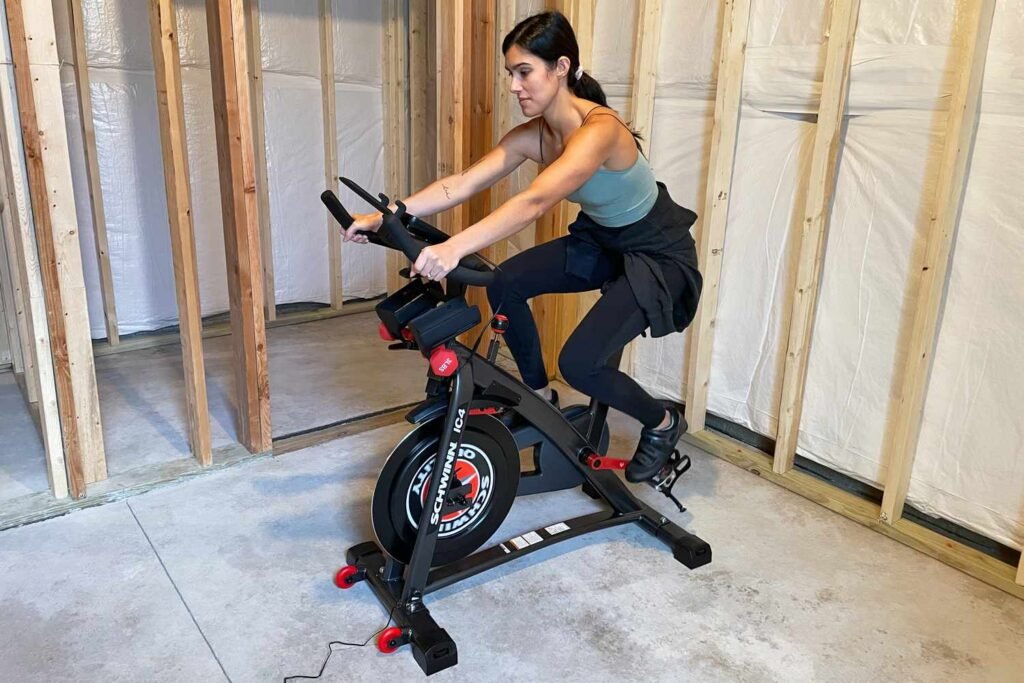
Can Exercise Bikes Damage Apartment Floors? (Realistic Answer)
👉 Yes — but only under specific conditions.
👉 No — in the vast majority of normal setups.
Let’s separate reality from paranoia.
✅ When Damage is UNLIKELY
For most users, problems are rare if:
✔ Bike is stable
✔ Floor is structurally sound
✔ Surface is not fragile
✔ Load is reasonable
✔ Protection layer exists
Modern apartments are designed to handle:
✔ Furniture loads
✔ Appliances
✔ Human activity
✔ Dynamic movement
An exercise bike is not an extreme load scenario.
⚠ When Problems Can Actually Occur
Now the important part.
Damage risk increases with:
🚨 Fragile Flooring Materials
Some surfaces are more sensitive:
⚠ Low-quality laminate
⚠ Thin vinyl planks
⚠ Floating floors
⚠ Older wooden boards
⚠ Weak tile installations
Not because bikes are destructive…
👉 But because materials respond differently to pressure + vibration.
🚨 Uneven Floors
This is MASSIVE.
If the bike rocks:
👉 Pressure becomes asymmetrical
👉 Stress becomes concentrated
👉 Micro-impacts occur
Which leads to:
✔ Tile stress
✔ Joint fatigue
✔ Surface wear
Uneven floors are the hidden villain.
🚨 High-Intensity Riding
Aggressive pedaling increases:
✔ Vibration amplitude
✔ Lateral force
✔ Frame oscillation
Still not catastrophic…
But mechanically relevant.
🚨 Lack of Protective Layer
Direct contact = higher stress transfer.
Simple physics.
What Most People Get Completely Wrong
Here’s the myth that causes confusion:
👉 “Damage only depends on weight.”
Incorrect.
In flooring mechanics:
🔥 Vibration + Repetition matter far more than raw load.
A refrigerator weighs more than a bike.
But:
✔ It doesn’t vibrate constantly
✔ It doesn’t shift laterally
✔ It doesn’t generate oscillating stress
This is why bikes FEEL risky.
Even when they usually aren’t.
How to Make Floor Damage Practically Impossible
Good news:
👉 Prevention is extremely simple.
And extremely effective.
✅ Use a Protective Mat (Game Changer)
A quality mat:
✔ Distributes pressure
✔ Absorbs vibration
✔ Reduces friction
✔ Protects surface finish
Mechanically speaking:
👉 It decouples force transfer.
This is HUGE.

✅ Ensure Perfect Stability
No rocking.
No wobbling.
No micro-bouncing.
If your bike moves:
👉 Fix this FIRST.
✅ Adjust Leveling Feet
Most bikes include them.
Underused.
Critical.
✅ Avoid Direct Tile Contact
Especially with hard plastic feet.
A Reality Check (Important Perspective)
If exercise bikes were inherently damaging…
👉 Apartment living worldwide would be chaos.
Millions of people use them daily.
Without structural disasters.
Without cracked floors everywhere.
The fear exists because:
✔ Damage stories circulate more than success stories
✔ Worst-case scenarios get amplified
✔ Internet loves drama
Reality is calmer.
Much calmer.
If you use an exercise bike at home, especially in an apartment, understanding how stability, vibration, and surface interaction work can make a significant difference in comfort, safety, and long-term floor protection.
If you’d like to explore related topics that help improve your home workout setup:
👉 Indoor Exercise Bike for Apartment: Quiet, Compact & No Neighbor Complaints (2026)
👉 Do Exercise Bikes Make Noise? The Truth About Sound, Apartments, and What Nobody Tells You (2026)
👉 Wenoker Exercise Bike Review 2026
👉 OWLSKY Exercise Bike with App Review 2026
👉 How to Stabilize an Exercise Bike on Uneven Floors (2026)
👉 How to Reduce Exercise Bike Vibration Noise (2026)
🔥 FAQ – Intelligent & Strategic
Can an exercise bike crack tiles?
Extremely unlikely under normal conditions. Tile damage usually results from poor installation, existing weaknesses, or uneven pressure caused by instability.
Is weight the main cause of floor damage?
No. Vibration, repeated stress cycles, and uneven force distribution are more mechanically relevant than static load alone.
Are wooden floors at higher risk?
Sensitive surfaces like low-quality laminate or floating wood systems benefit greatly from protective mats and proper stabilization.
Does intensity of riding matter?
Yes. Higher pedaling force increases vibration and lateral stress, though still rarely problematic when the bike is stable.
What is the safest setup for apartment use?
Stable bike + leveling adjustments + protective mat = mechanically optimized and low-risk configuration.
The True Risk is Not Damage — It’s Neglect
Most flooring issues arise from:
❌ Poor installation
❌ Existing weaknesses
❌ Uneven surfaces
❌ Lack of stabilization
❌ Long-term friction
👉 The bike merely exposes vulnerabilities.
It rarely creates them.

